Friday, May 18, 2012

Love of Authority

I think your objection is coming from a love of authority
This is the opening comment in CD Host's response to my last post.  It is interesting because it is more of a psychoanalysis than a logical reply. As such it suffers from the ad hominem fallacy. Not that it is an insult. I don't think it was meant that way. It is however an attempt to dismiss my argument by pointing out an issue with my person. That is not a legitimate line of reasoning. Still the issue with my person is worth thinking about.

Do I have a love of authority? I think all humans have a love/hate relationship with authority. We have a desire to understand ourselves as part of something bigger. It is one of those religious urges that atheists keep complaining about. For some reason they complain to Christians rather than to evolutionary scientists but that is another matter. We want significance. We want our life to make a difference even long after we die.  So we become a part of something that we thing will make that difference.

That explains why so many atheists are so liberal. They see the liberal establishment as their vehicle of significance. That is why so few liberals actually step away from fashionable liberal ideas and think for themselves. The authority of that group is more dogmatic and their excommunications less merciful than with Catholic church. They are anything but free thinkers. Like a teenager who rebels against his parents saying he has to be true to himself and then immediately joins a gang. Often when we seek freedom all we get is freedom from the previous situation. We don't get true freedom. It is just a new form of slavery often worse than before.

If we are humble enough to see ourselves as needing authority then we can make better choices. Jesus saw the crowds as sheep needing a shepherd. We often see the crowds that way. But do we see ourselves as just one more sheep? That is a lot harder. Those masses need a shepherd. I need to think for myself. The truth is we need both. We need an authority that enables thought and does not stifle it.

It occurs to me that our authority needs to be legitimate, limited, and logical. I know the 3 L's makes it sound like a sermon but bear with me. It has to be legitimate in the sense of having better access to the truth than I do. I really want more than that. If I trust an authority and it steers me wrong that can ruin my whole life. I need to be sure that is not going to happen. But it has happened to many good people who followed movements that proved to be very wrong. You really want some sort of infallibility. That is some sort of guarantee that your vehicle of significance is not going to crash and burn.

Then you want something that is limited. This is important if you want to be a free thinker. The authority should not try and define in great detail what you should be thinking. It has to set some boundaries. If it does not then there is no purpose to having it. But when humans have power they tend to abuse it. They tend to use it most strongly precisely when they should not use it at all. For example the strong punishment by liberals of anyone opposing gay marriage. It is an attempt to stifle thought through the use of raw power. It is working. All liberals recite the same lines when discussing this issue. Even Obama must bow down and mouth the new creed. Not because it is intelligent. An intelligent idea would not need such bullying to become popular. It is precisely the stupid ideas where we see this effect most strongly.

Lastly, authority has to be in logical. If you force people to accept truths that are against reason then you make a person irrational. There is something inhuman about making a person irrational. We are not really capable of it. People try and believe something on faith despite it being against reason. The trouble is when you do that you can't consistently accept any conclusion based on any logical argument. Who can live that way? So you decide which logical arguments you will accept and which ones you won't. But it is arbitrary. It is a mess.

So do I desire such an authority? I think we all do. I think when we do we are really desiring God. More precisely we are desiring the Catholic church. It is part of the God-shaped vacuum in our hearts that Pascal talked about. Sometimes it is hard to see. Many have left the church precisely because they seek a legitimate, limited, and logical authority. But it is not to be found anywhere else.

Monday, May 14, 2012

Arguments and Choices


Having a great discussion with a guy who calls himself CD Host. It is long but I like it because he makes me think. If you don't get any quality opponents then you can get lazy in your arguments. He is not only smart but also polite. No insults. No cheap shots. So I am happy to have him.

It does make me wonder about the relationship between argument and religion. I have talked about the mutual admiration society where people just reinforce each other other and make each other more and more certain they are right and everyone else is just a bit off. There is a bunch of that happening. But then there is the argument between two people of opposing views. What is the point there? I am wondering if the goal should be to convince and win converts. There are some people who are argued into religion or argued out of it but that is rare. I am not sure that is a good thing when it does happen. I don't think God intended anyone to be coerced into Christianity. He didn't give us the evidence to be able to do it in general. We can if have a weak opponent but should we?

It became clear to me when I tried arguing from history or from sociology that evidence can quite easily be viewed multiple ways. I can look and see the hand of God plain as day. An atheist can look and see nothing remarkable. It ends up being a choice. That is how God wants it. He wants us to freely choose for Him or against Him. He does not want to force Himself on anyone.

So what is the role of argument? Argument, if it is done right, won't really produce converts by the force of logic. What it will do is clarify things. It will clear away all the grand claims and dig down to the most basic assumptions. What is the foundation of the Catholic world and life view and what is the foundation of the atheist world and life view? At that point we won't be able to say one is logical and one is illogical. They will both be valid choices. In the final analysis it won't be logic but beauty that makes Catholicism more attractive.

In the end the materialist world is possible but it is something the human heart will have trouble embracing. A world where love is mere brain chemistry. A world where nobility and greatness are illusions that gave us survival advantages at some point in our development. A world where Hitler can't be considered better or worse than Gandhi in any absolute sense. They just are. If you can strip away everything from atheism that has no foundation within the atheist worldview and make clear exactly what is being proposed then you can expose it's ugliness. You won't be able to disprove it. Some will still hold fast to it based on that alone.

Conversely the Catholic world view is not provable. Not in the absolute sense that someone who denies it will feel they are being irrational. But you can clarify it. You can clear away a lot of the mud that is thrown at it. You can correct the distortions. You can explain the alleged problems. If you do it right you will expose the true faith. People will be able to see the real beauty of the church if they are willing to look. For many, one good look and they are hooked. But that is precisely why many won't look. They feel themselves being sucked in. It is always a choice.

So what changes when you are arguing with a protestant rather than an atheist? Not much. The ugly bits of protestantism are different then the ugly bits of atheism. But they hide the ugliness in similar ways. They both borrow from Catholicism without admitting they are doing it. Atheist love to bring in morals and meaning. Protestants love to bring in the bible and Christian tradition. Things that seem obvious but they can't get them from their own belief system. They need to import them. Once you strip away the imports and you deal with naked atheism or naked protestantism then you have done all you can with logic. Then it is a matter of the Holy Spirit leading their heart to choose beauty.

There were moments like that with CD Host. Where after a few questions he was saying some things that were downright scary. An example:
in real life goods compete with one another and wrongs compete with one another. We often have to do wrongs to avoid greater wrongs. Even if I were convinced the fetus were human and the mother wanted to have the child you could still potentially justify abortion based on the energy argument. If a society needed to use infanticide to avoid massive famine and plague they would be doing the right thing, even though I have no problem considering infanticide a wrong.

This is why frankly I find Christian morality not "too hard" as you keep accusing me of but quite often destructive and evil. It starts with the assumption that moral goods are coordinated rather than understanding that in real situations moral goods are often in conflict and the moral thing to do is weigh between them and decide what is the best outcome. Achieving the greatest good for the greatest number often means doing a thing that in isolation would be wrong.
Could this be right? Logically there is nothing impossible about it. But it means absolutely everything and anything is justifiable in pursuit of the "greatest good." How is that defined? It really isn't. The closest I got was:
Stevenson , "Emotive Meaning of Ethical Terms" is a classic philosophical book that defines morality as purely a class of emotional reactions.
So you have emotions (or something similar to them)  being used to define the greater good. Then the greater good is used to justify anything that would in isolation be wrong. Anything ... to anyone ... on any scale ... without limit. At some point a person might see that this if this is the real world it is a pretty ugly. It is a choice.

Friday, May 11, 2012

Boys And Tackle Football

Contact sports are really taking a beating. Hit hockey and tackle football are all over the news. Concussions are the story. People get hurt. Why play a dangerous game? Why not just take the hitting out? Why not choose a nice sport like lawn bowling or something?

The trouble is we don't want to teach our boys to always be nice. God has given boys the impulse to be warriors. They want to compete hard. They need to go beyond nice, polite competition. They need to be aggressive. They even need danger. The important thing is to be able to do all that and stay in control. They need to avoid letting their anger get away and doing something stupid. They need to play hard and play smart at the same time. They can't be afraid to get hurt and can't be afraid to hurt someone else. They need to play within the rules but if the rules allow you  to hit someone hard then you hit them hard. Christian men are not supposed to be soft.

When they get into business or get into politics or whatever they do in life they need to be moral but they can't be afraid. If they have a chance to destroy an opponent they need to be able to do that. It does not typically involve violence but it is a type of aggression. You don't want to raise wimps. Christians need to walk into a danger zone and not only overcome their fears but be able to make the other guy afraid of them. You don't break the rules but you play the game hard and you don't apologize for it.

There are a ton of important life skills learned in a team sports. The importance of hard work. How to perform when you are exhausted or in pain. How to accept leadership. How to deal with more talented teammates and with less talented teammates. How to help each other stay focused and hold each other accountable. How to work with guys you don't like. How to perform when everyone is watching. How to work hard when nobody is watching. So many skills that translate directly into any area of life. But they are learned in a very physical way. There are lectures but they are constantly backed up by the undeniable physical reality of getting hit.

Fr Barron talks about boys becoming men. Rites of passage are needed. Boys need men other than their fathers to push them. To signal to them that they are men and they can take on the world. This is one place where that happens. You go after something that other people want very badly and you try and take it from  them. The winners will be overjoyed. The losers will be bitterly disappointed. Bring it on.

Everything that is worth anything in life needs to be fought for in that way. To many Christians think their job is to just be nice and God will make everything just work out. There is a reason why one of the major Christian virtues is courage. How do we instill that virtue in our boys? I think contact sports help a lot.

Wednesday, May 9, 2012

How Bad Theology Leads To Atheism

I was reading a story of a pastor who became an atheist. He talks about it starting with doubts about the doctrine of hell.
DeWitt's transition from true believer to total skeptic took 25 years. It began, he said, with the idea of hell. How could it be, as he had been taught and preached, that a loving God would damn most people to eternal fire? "This thing called hell, it began to rock my world," he said.
From there he read about universalism — the idea, scorned by most fundamentalist Christians, that salvation is universal, and all people will be restored in their relationship with God without any action on their own part. After universalism, he discovered the idea, supported by some neuroscientists, that God is actually our inner dialogue.
"I went from God loves everybody to God saves everybody to God is in everybody," he said.
So that is a bit scary. Lots of people have trouble with the idea of hell. Are they all going to become atheists? Hopefully not. We need to go back and ask what makes the idea of hell so hard to accept? One source of that problem is when we make heaven too easy to accept. Heaven can seem easy in many fundamentalist churches. You say the sinners prayer and you are saved. Isn't it great? The most amazing gift is available totally free. You just need to ask. But not everyone asks. So they go to hell. How is that fair? It is like God will give you $1 billion but only if you say Rumpelstiltskin. If you don't say it then too bad so sad. What kind of God does that?

The trouble is this view of salvation is wrong. It ignores what heaven is like and it ignores what we are like. The big thing about heaven is it is a community. We often think of it in individual terms. Sometimes we thing of union with God but often not even that. We can think of heave like going to Disneyland. If that is what it is like then there would be no good reason for God to refuse everyone entry.

But the joys of heaven depend completely of the fact that they are shared with God and with each other. We will know each other fully just as we are fully known. That is why it is so important that nobody with any sin at all be in heaven. A community of perfect love requires total self-sacrificing love from everyone involved. If one person breaks that than the whole thing breaks down. So we need to be sure nobody there is going to use us or ignore us or disrespect us. We are to live the way God meant us to live. To love and be loved without limit.

So if you see that we must be perfect in love to enter heaven you can start to see why not everyone will be there. But why does God not just make everyone perfect? Problem solved. But making someone perfect is a big thing. We are serious sinners. We don't just sin big but we sin in the most personal ways. For God to make such sweeping and intimate changes to a person's life requires their permission. We understand that forcing somebody to marry against their will is a violation of their dignity as human persons. Forcing somebody to be supernaturally transformed into the image and likeness of Jesus would be many times worse. God will not do it.

But what if God just makes an argument so convincing that everyone is going to say Yes? The trouble is that would still be forcing. Just in a different way. The nature of love requires it be a real choice. It even requires the choice not be simply self-serving. It must not be a choice we make because everyone else is doing it. Quite the opposite. The option of saying No must look easier. That is the only time we know we really love someone or something.

The other thing we need to know about heaven is how right it is. It is where we are meant to be. It is who we are meant to be with. It is how we are meant to be with them. Everything about it is right and not just right on a superficial level. It is right for you right down to the depths of your soul.

What follows from that is that missing out on heaven is very bad. If we are not forced even in the most sneaky way then many will be excluded. If it is so right then that exclusion will be very sad. We are meant to feel that sadness. We are meant to do something about it through evangelism. But evangelism involves the whole mystery of a person be transformed from a sinner into a saint. To reduce it to walking a aisle and saying a prayer turns the whole thing into nonsense. Once it stops making sense then we will be tempted by atheism.

Thursday, May 3, 2012

More Discussion - mostly on abortion

CD Host is green. My words are red

 I am still not clear on how [Consent is the driving principle of sexual morality] becomes different from moral relativism. That is that no sexual act is immoral by it's very nature. That it is a person's reaction to the sex act that makes it moral or immoral.

SSC is a well accepted non-religious morality of sex. A sex act is moral if it meets the 3 criteria:

a) Safe = That is it doesn't expose either party to excessive danger. There needs to be focus on best / safe practices to ensure the maintenance of health for both parties. And wherever there are unavoidable risks the parties need to be fully aware of the risks and consent to those risks.

b) Sane = The people offering consent are capable of good judgement. That means no permanent (like retardation) or temporary (like drug use) mental impairment. This is the rational man standard, that a rational man confronted with this sexual choice would make the sexual choice of the parties involved.

c) Consensual = Even if a person views an activity as safe as sane they still need to desire to partake of it at that time with that partner.

I'd argue that SSC is non-relative but situational moral standard. That is it establishes moral absolutes about sex, but those absolutes can only be applied in the context of consent.
I don't see a lot of absolutes here. I see a few nice words. As soon as you attempt to be precise about what they mean you get into very subjective language. What danger is "excessive?" Who decides "best/safe practices?" Who decides when someone's consent is impaired? Doesn't this just boil down to how I feel? 

Sexual choices are often made when someone's emotions and/or hormones are preventing them from thinking straight. Subjective criteria like this don't work well. In the heat of the moment you can discern something to be right and the next morning you can decide it was wrong. The same act might be deemed moral by one half of the couple and immoral by the other. It seems pretty much unworkable.
 
It is very similar, to contract law in our society. Sex is seen as essentially a contract between private parties. 
Contract law has one huge difference. There is a government and a court system to make contract law precise. Here there is nothing but my often quite biased opinion. Even the basics of SSC. Where do they come from? Why can't I just change them? The truth is I can. If I want to declare a date rape drug to be OK then I can amend (b) or drop it entirely. But morality is only useful when it gets hard. When we would have done the right thing anyway then it is not really helping us. It is when we would have done something wrong that we need it. But that is when we are going to be tempted to change it. If it has no foundation and no definition outside myself then why wouldn't I change it?
 
And I don't think consent as a criteria is necessarily that controversial. Most religious conservatives would agree that marital rape can occur (i.e. is definitionally possible) and is immoral.
Consent is not controversial but it can't be the whole thing. It just makes morality based on community opinion rather than personal opinion. In this case the community consists of the participants in the act. That is still relative.
 
In keeping with this contract view of sex, the SSC criteria says that if an individual engages in SSC actions they become responsible for consequences while if SSC is not met the other party is responsible for the consequences. So for example if a woman decides she loves her husband enough to have sex with him knowing he has AIDS and contracts AIDS she is responsible. If a woman has sex with a man not knowing he has AIDS and contracts AIDS she is not responsible.
I think this woman would know she is responsible in both cases. Counselors would tell her that she is not. They always say that. It does not really matter. Forgiveness is still the key. Can you ask for and accept God's forgiveness for yourself and the other person involved? 
 
Again this is similar to how we view lots of health related issues. For example as a society we treat liver failure as a result of excess drinking much differently than liver failure as a result of contagious disease.  
We do? I think if the person is still drinking that would tend to make them bad candidates for a liver transplant. Just like a liver disease that would destroy the new liver as well. If the excess drinking problem no longer exists I don't think the fact that the cause was moral rather than medical should be relevant. 
 
If we apply this to the situation of a conception due to rape to Rita vs. a conception due to birth control failure for Francine.

Francine doesn't want the health effects of hormonal contraception (safe) and so uses a diaphragm with spermicidal gel. She understands there is a risk of conception. They engage in sex. They understand they've increased the risk of pregnancy but did so for sane reasons to compensate for other another risk (i.e. hormonal effects). This act meets the SSC criteria. Francine and her husband are capable of raising the child. Many moderates would view an abortion in this situation as immoral, she consent to a higher chance of conception.

Conversely Rita does not consent. The rapist did not consult with her before failing to use a condom. Thus many moderates would believe that an act of violence took place and just as she is allowed to use violence to avoid the rape, she is allowed to take strong measures to correct for any consequences of the rape. Rita, because she lacked any moral agency, did not engage in sex and is free to treat the health risks of conception with the SSC criteria. Pregnancy is not safe, bearing a rapists baby is not something that any rational person would do and she did not consent.

This moderate position view abortion as a negative. A negative substantial enough to overrule Francine's objections but not such a strong negative as to overrule Rita's legitimate rights. The pro-choice position is that abortion is even less of a negative and thus the negatives of pregnancy are high enough and statistical consent is not strong enough that Francine retains her rights to terminate like Rita.
 
This is just nonsense. I know you don't hold this position. You would say both Rita and Francine have every right to abort their children. I think you do a good job of trying to show how the "moderate" position is reasonable. I just think it fails completely. Is the fetus human? If it is not then the justification for denying Francine an abortion is just silly. If it is then the justification for saying Rita can abort is worse than silly. It is frightening. 

Say you come upon a man in danger of death and you have a real chance to save him. Should you? What if I answered that it depends how you came upon that man. If it was your idea to go down that road you have to save him. If someone else pressured you or even forced you to go there then you can leave him. Would that make any sense to you? You are there. Who cares how you got there? 

I see the same thing with Francine and Rita. The question of whether they chose to come down this road or not does not matter. They are on the road and they need to make a choice based on the value of the life involved. It might not seem fair but life often seems unfair. 
 
I also don't agree with what you said about energy consumption and keeping fertility at 1-3 children per woman. Who cares about vague notions like standard of living. We don't need energy to have a good life. We need to love God and love each other. You can live very fulfilling lives and still have what the experts would call a low standard of living.

Not for long. If the median woman is having 10.5 kids at an average age of 30 (i.e. one child every 2 years 18-40) then population is growing 400% every 30 years. That's about 4.75% annual growth in population. Assuming that the one time jolt of introducing that many children only halves global output we are down to about $31t in global output. At about $1000 / yr /person you start having starvation and disease problems. If energy is growing at only 2% per year then living standards are falling 2.75% per year or falling by 14/15ths per century. I want you to think about what your standard of living would be like at 6.6% of your current salary. And then remember you live in the first world, in a rich country what's happening in Bangladesh or Mali?  
 
So within 100 years most of the population is starving to death or dying from exposure and the "holocaust" of abortion will pale in comparison to what's God's methods of birth control: war, famine, disease and sanitation failure will do. That situation just a century out is totally unacceptable even if you only care about preserving life and not the quality of life.

Math is amoral. If humans choose to breed like rats then they will die like rats.

This is just silly. People don't have 10 children on average (I am guessing you are not married). The human species has been around for a long time. It does not happen. These kinds of arguments actually go back to the 19th century. There was the iron law of wages and some similar thinking by Thomas Malthus. One problem is real data has never really fit the theory. People don't breed like rats.   

The other problem is we are not intended to build utopia. We are to live good moral lives. That is how we avoid being like rats. We just are not competent to figure out how many people should be in the world 100 years from now and manage society towards that goal. We need to let God worry about the big picture and focus our energies on the things we can control. 

The central problem of overpopulation is not the number of people but the way they interact. When people are self-absorbed and constantly using and abusing each other then the world is going to seem overpopulated. When people treat each other with love and respect then more people will seem like a blessing. 

Trying to solve these problems with contraception and abortion is essentially giving up on the concept of human dignity. Human life stops being a great gift and starts being a problem to be solved. It leads to genocide as legitimate government policy. Math is amoral. It sure is. So throw out the math and love the child. I have a university degree in Mathematics. I love equations. But matters of life and death should not be based on global calculations. 

If a Catholic society wanted to avoid a population increase they would have fewer people marry. Marriage would still be about procreation. Just a higher number of people would live as consecrated celibates. They would improve society in other ways while those called to marriage would continue to have large families.

A decrease in marriage decreases fertility greatly no question. It does to some extent decrease sexual activity but not nearly enough. A society with huge numbers of semi to fully sexually active people who aren't socially and/or legally permitted to be pregnant is not going to lead to less abortion.

The problem here is you don't think Catholic morality is actually livable. That celibacy cannot act as a population control because people will always cheat. I believe in grace. That God can enable us to live a life of love and sacrifice that would not be humanly possible. Will some people cheat? Sure. But Catholic sexual morality can be lived as the rule and not the exception in real world societies. 

Look at the Roman empire. Sexual perversity was rampant there. Christianity was able to take hold. It can happen. It is not only possible but it is essential. A lack of respect for sex and for life will cause civilization to fall apart. It is not compatible with human rights and human freedom long term.
 
That is because science has now shown the fetus to be human right from conception.

And this is where we get to the crucial point. I'd disagree. Moreover I'd argue that this is not a question science is even capable of answering. "What is human" is a moral question not a scientific question.


Science can say that a fetus is a living thing right from conception. Not only that science can tell us the species. It is homo sapien. So we are left with two choices. Just accept that it is human or try and dream us a new category for something that is alive and the same species as humans but not human.

When you take the second option you open the possibility of anyone anywhere doing the same thing with a people group they don't like. It can be based on race or on disability of age or anything else. Once we say being alive and being a member of the homo sapien species is not enough. Once we say we can add arbitrary criteria to the definition of what counts as human then anybody's human rights can be denied.

So the pro-abortion position is really anti-science. Pretending science has this unanswerable question involving what it human. It is only unanswerable because you don't like the obvious answer. Who counts as human? Everyone. Every human person, no matter how weak or how strong, no matter how young or how old, no matter how productive or how burdensome, no matter how welcome or how inconvenient. Nobody is a nobody; nobody is unwanted. All are wanted by God, and therefore to be respected, protected, and cherished by us…

The last bit comes from here:

http://www.equip.org/hank_speaks_outs/richard-neuhaus-on-abortion
 
 
I think we have gotten off point a bit. The original argument was one whether the pro-choice position was utilizing moral relativism in its assessment. You latest post is essentially a series of assertions, you are using the "say it louder" type argument. Catholic theology is going to be much more conducive to moral questions than the utter amorality of science. I'm going to chase you down the rabbit hole because I think you believe these things are true and they are preventing you from seeing that you actually picking criteria arbitrarily.

Not only that science can tell us the species

First off, species is considered by science to be a cultural not a scientific classification. It is determined by breeding patterns. That is genetically compatible animals that don't breed with one another are not considered to be part of the same species. You might have learned the capable of producing fertile offspring definition but that is now considered outdated because it was impossibly to apply consistently. 

I don't know that any of this is true. I have seen reports of scientists saying that species determination involves genetic research.
http://www.seaworld.org/animal-info/info-books/elephants/scientific-classification.htm

Moreover, and most importantly, species classification is not applied to individuals but to communities. For example individuals can be infertile and thus not capable of producing fertile offspring at all with anyone.  

So an infertile individual is not a member of the species? I don't think science is that stupid. I mentioned this was anti-science. I think you are twisting the science to make the species question seem hard.

So no in a quite literal sense science can't tell us the species of the "preborn". Moreover biologists who do taxonomy classify young into two phases embryo when species are not fully differentiated and fetus when they are. This change happens in homo-sapiens at the 8th week. So if we are going to rely on the species definition the cut off would be, 8 weeks not conception. This incidentally is precisely what Catholic doctrine held in the 14th century, that at the 8th week the child was "fully formed" and thus inducing labor beyond this point was abortion. E
The key word here is "fully." This differentiation is gradual. So there is no obvious point at 8 weeks where you can say now this thing is human. Certainly the DNA does not change. Certain things happen at certain stages in a person's growth. Teeth grow at a certain point in development.  The child is not more or less human as a result. Differentiation is like that. Just another stage in the process of growing up. Actually many stages because it is not just one event. At no point does the nature of what it is change in a fundamental way.
 
Experimentally this cutoff is verified daily in drug manufacture. Cloning works on this very process. Because of there are undifferentiated cells you can grow human DNA inside bacterial cells.  
So because we abuse it it must not be human? That was the logic of Row v Wade, if we start killing them then people will stop thinking of them as human. Actually every genocide had the expectation. To some degree it works. Then there that pesky Catholic church with a long institutional memory and principles thinking.
 
My guess is that at this point you are going to drop "species" and the key cultural and biological components and then go to the genetic argument. Which is going to also fall apart.  
Why? Because you expect me to find this convincing? Science says a fetus is human. You can't get around it. As a Catholic I can embrace science. My creed never forces me into such anti-science position as you have just taken. No disrespect. Fundamentalists take anti-science positions. Lots of people do. I just think it is a sign of an error somewhere.
 
Once we say we can add arbitrary criteria to the definition of what counts as human then anybody's human rights can be denied.

Which is precisely the argument that PETA makes. They draw the line as what counts for rights as being able to attempt to avoid pain and thus argue that essentially all animals are entitled to rights. They see your "human" as arbitrary. And they have a 2600 year history of being able to apply this doctrine consistently.
They see my "human" as arbitrary. So then it is not "precisely the argument PETA makes." They make the error on the other side. We can lower human dignity by making other things equal to humans or we can lower it by excluding some humans.
 
Ahimsa, the idea that it is immoral to commit violence, and thus to eat meat, strikes me as morally consist. I may not agree but at least I find it plausible. Frankly, if we are talking about what is obviously true pretending that cell clump without a brain, getting nutrition from absorption not digestion, and unable to respond to stimulus deserves the full protection of homicide laws while an adult dolphin does not deserve any meaningful protection doesn't strike me as obvious, as you had claimed, in any sense.
I find it very sad to see someone be OK with abortion and yet get upset over cruelty to animals. It shows me how far humanity has slipped into immoral and irrational behavior. How choice is not an argument anyone wants to apply consistently. If they are really personally opposed to violence then they should oppose it even when it is politically incorrect.
 
Going in the other direction up till about 60 years ago people who liked your species definition had strong miscegenation laws. If whites and blacks formed a single breeding group then there were part of the same species. If they didn't breed they were two species. The species definition was key to justifying racial slavery and racial discrimination historically. Similarly this is why German anti-Semites thought breeding with Jews was a race crime, and clarifies what they meant by it. So just to be clear, the species definition does not even produce the ethics you were aiming for.
Like I said. I don't think you species definition is right. But even if it is then why would physically preventing breeding make them a different species. The fact that you have to prevent breeding means it is possible for them to breed. So we are talking about an irrational policy. So what is you point?
 
Who the society is going to protect is a choice the society makes. The choice is unavoidable there is no obvious natural cutoff. "Everyone" is by its nature meaningless. We as a society have to choose what we value. Right now we are moving towards a consensus on valuing intelligence. So in a widespread way catching dolphins in tuna nets is immoral, even though the whole point of the tuna nets is to kill tuna.  
This is scary. When it comes to human life we need to avoid choosing who to value and who to discard. Everyone is not meaningless. Everyone is the only answer that means anything. Every other answer means we will kill group X today and tomorrow we will kill group Y. Some day we will kill you or your children. 

Who cares about society's consensus. Society gets this wrong all the time. If we value intelligence then we kill Mother Teresa and Ludwig von Beethoven. We simply are not qualified to separate the good humans from the bad.
 
I applaud legal protections being applied to higher primates. We, the human culture, will create a network of protection which will protect and reinforce our goals as a culture.

As an aside, this post and your previous one contradict. I agree we should aim for a society where people are respected, protected, and cherished. To do that requires the very living standard you dismissed in your previous post. Without enough energy per capita they can't be fed much less cherished.
I know you don't worship the God that I do. Try and accept I don't worship energy per capita the way you do. I will cherish my fellow humans even when you equations say I can't. It does not depend on living standard. St Francis of Assisi talked about the gift of poverty. That being poor brings you closer to God and therefore leads to deeper joy. If living a moral life leads to more poor people that is no reason to be immoral.

I don't think it is true. I think moral societies tend to be more prosperous. I know capitalists say that greed produces wealth. You say that abortion produces wealth. I don't buy it. I would say that virtue leads to wealth. When America and Europe were moral there were prosperous. Since they have abandoned Christianity for secularism their prosperity has diminished. I would even say Christianity leads to scientific and social progress.

Tuesday, May 1, 2012

10 Points From Happiness And Well Being Research

I was reading an article about commencement speeches. He does what is typical and talks about how most commencement speeches are useless and his is so much better. As is also typical he is much better at criticizing what others are saying then he is at coming up with something better. Human wisdom is like that. You substitute one opinion for another. But often there is no good reason to believe you are closer to the truth.
In the decades since, I've spent most of my career teaching economics and public policy. In particular, I've studied happiness and well-being, about which we now know a great deal. And I've found that the saccharine and over-optimistic words of the typical commencement address hold few of the lessons young people really need to hear about what lies ahead. Here, then, is what I wish someone had told the Class of 1988:
The key phrase here is "happiness and well-being." What does that mean? Is that what we should be pursuing in life? That is not at all clear to me. It sounds more like big brother has done all the real thinking. All we have to do is follow a few simple steps and all will be well.
1. Your time in fraternity basements was well spent.
The same goes for the time you spent playing intramural sports, working on the school newspaper or just hanging with friends. Research tells us that one of the most important causal factors associated with happiness and well-being is your meaningful connections with other human beings. Look around today. Certainly one benchmark of your postgraduation success should be how many of these people are still your close friends in 10 or 20 years.
What are "meaningful connections with other human beings?" Is that the same as just hanging out with friends? I know I would fail his test of keeping up with my friends from college. But in college I didn't know how to have meaningful relationships. So making that a benchmark of my success would have been quite a mistake.
2. Some of your worst days lie ahead. Graduation is a happy day. But my job is to tell you that if you are going to do anything worthwhile, you will face periods of grinding self-doubt and failure. Be prepared to work through them.
This is good. People need to be prepared for suffering. It happens to us all and we are shocked when it does. A few words to make us a little less shocked are helpful.

3. Don't make the world worse. I know that I'm supposed to tell you to aspire to great things. But I'm going to lower the bar here: Just don't use your prodigious talents to mess things up. Too many smart people are doing that already.
This is seems to be setting the bar low but in reality people can't do even this. In order to do this you need to know what is good and what is evil. Then you need to choose good over evil. Without God's grace you can't do either of these things.

He uses a lot of terms that imply a sense of how people ought to live. But he gives no hints as to how to get such a sense. A commencement is a time to highlight the important things in life. But he does not seem to be willing to say clearly what they are.

4. Marry someone smarter than you are. When I was getting a Ph.D., my wife Leah had a steady income. When she wanted to start a software company, I had a job with health benefits. (To clarify, having a "spouse with benefits" is different from having a "friend with benefits.") You will do better in life if you have a second economic oar in the water. I also want to alert you to the fact that commencement is like shooting smart fish in a barrel. The Phi Beta Kappa members will have pink-and-blue ribbons on their gowns. The summa cum laude graduates have their names printed in the program. Seize the opportunity!
So marriage is about a "second economic oar in the water?" He associates it with doing "better in life." So doing better in life is about money? Marriage should be about money too? He says marry someone smart but he immediately translates that into professional and monetary success. What about love? What about children? What about someone who will be faithful? I feel sad for him and his wife that this is the best marriage advise he can give after 25 years.
5. Help stop the Little League arms race. Kids' sports are becoming ridiculously structured and competitive. What happened to playing baseball because it's fun? We are systematically creating races out of things that ought to be a journey.
He is right about this. Especially for teens there is the idea that you have to play a sport very seriously or not at all. I am not sure how much of that is the parents and how much of that is the teens. Drama, music, robotics, etc. are the same deal. Spend endless hours to be the best you can be or opt out completely. The option of doing a little of everything becomes very difficult at a very early age.

6. Read obituaries. They are just like biographies, only shorter. They remind us that interesting, successful people rarely lead orderly, linear lives.
So life is messy. But should there not be some central guiding principles that guide it? It is good to reflect on what you want your life to look like when you die. But he seems to think the definition of "interesting" and "successful" are obvious.  I think they are anything but. Which biographies or obituaries will you read? The ones of summa cum laude graduates? What about the saints?

7. Your parents don't want what is best for you. They want what is good for you, which isn't always the same thing. There is a natural instinct to protect our children from risk and discomfort, and therefore to urge safe choices.
He continues his aversion to giving any specifics about what is good or great or worthwhile or successful or any of these other value laden words he uses. But he is sure that a person's parents are going to give the wrong answer. Lots of people have complicated relationships with their parents. Some parents discourage risk taking. Some push their kids too hard. Parents are not all the same and they are not always wrong.
8. Don't model your life after a circus animal. Performing animals do tricks because their trainers throw them peanuts or small fish for doing so. You should aspire to do better. You will be a friend, a parent, a coach, an employee—and so on. But only in your job will you be explicitly evaluated and rewarded for your performance. Don't let your life decisions be distorted by the fact that your boss is the only one tossing you peanuts. If you leave a work task undone in order to meet a friend for dinner, then you are "shirking" your work. But it's also true that if you cancel dinner to finish your work, then you are shirking your friendship. That's just not how we usually think of it.
This is an interesting thought. I think we get different kinds of peanuts for different kinds of tasks. But it begs the question, if peanuts should not be the driver then what should be? How do we decide how much time at work is too much and how many dinners with friends is too many or too few? But it is true that many people end up spending too much time at work.
9. It's all borrowed time. You shouldn't take anything for granted, not even tomorrow. I offer you the "hit by a bus" rule. Would I regret spending my life this way if I were to get hit by a bus next week or next year? And the important corollary: Does this path lead to a life I will be happy with and proud of in 10 or 20 years if I don't get hit by a bus.
This puts a lot of pressure on. As a Christian I am glad I can let God worry about how much time He is going to give me and whether it is worthwhile. Trying to make sure my life works out in the midst of huge unpredictable events like getting hit by a bus is just beyond what I can do. If I follow God as best I can and let Him worry about the big picture then I don't have to wonder about regrets or whether I will be happy in 10 years.
10. Don't try to be great. Being great involves luck and other circumstances beyond your control. The less you think about being great, the more likely it is to happen. And if it doesn't, there is absolutely nothing wrong with being solid.
What does greatness mean? St Therese of Lisieux saw it as doing little things very well. God made her great. You can call that luck if you want. But she did the best she could with the situations she was given. I think that is what he means by not trying too hard to be great. Just settling for a humble life and not forcing yourself into the center of the action unless there is good reason to do so.

It helps here to believe that it does not depend on "luck and other circumstances beyond your control." That would be quite depressing to think my life's significance depended on such things. Even having to figure out what defines greatness and significance would be quite oppressive. What if you get it wrong? You can spend your life climbing a big mountain but which one should you choose? This is the question he does not want to address. What if I become a big time lawyer and figure out later I should have spent my life helping the poor in Africa? Does it matter? Why does anything I do matter?

It seems like the research on happiness and well-being has a long way to go. Most of this is pretty much common sense. But it is common sense once you have defined what the center of your life is about. It makes no sense if you don't have that figured out. He does not dare give you any explicit help in that area.

He says he wishes he had this advise in 1988. I wonder what point he would have found helpful. Really it makes me think that contemplating life from a secular, scientific perspective rather than a religious perspective is a waste of time.  At best it is a waste of time. At worst it gives you lousy advise that you hope young people are smart enough to ignore.

Discussion With CD-Host

Moving the discussion below here so I can use colors. CD-Host is green. My words are red.
Hi Randy --

Good answers.
Thanks, I enjoy the discussion

Pro-choice people make it all the time. Don't like abortion? Don't have one. What is the argument? All morality is personal likes and dislikes.

Good example, that is a tough one. I would hope that this is not an argument from moral relativism since obviously that would be a stupid argument. 
You are being very charitable. I don't tend to assume pro-abortion arguments are not stupid. They are more sound-bytes than arguments. Still people are convinced by them.
 
Rather it is a more subtle argument along these lines:

1) Consent is the driving principle of sexual morality.
2) Abortion should be classified along with sexual morality and not a crimes of violence.
c) An objection to abortion is just an objection to consenting to have an abortion.

Now obviously (1) and (2) are highly contentious and most people making this argument often haven't really thought through those two underlying assumptions. 
I wonder if (1) is not just moral relativism in disguise. Matters of life and death have deeper moral issues involved than mere consent. Sex can involve the creation of a new human life. Why should we expect consent to be the driving principle unless we have bought into moral relativism at some level? 
(2) is the reason that discussion of the fetus' development is so effectual in pro-life arguments because once one accepts that abortion is the deliberate dismemberment of proto-human, (2) is a harder belief to defend. 
I am not sure (2) is even on most people's radar. Is abortion a matter of life or a matter of sex? The sex part is over before the abortion question comes up. The sex could have been rape. It could have been consensual married sex. Mostly how a person got to that point does not matter. Mostly, people are pro-abortion regardless or pro-life regardless. That much makes sense. The central question is whether it is OK to kill the fetus. That is a life issue. I am not sure I have ever heard someone frame it as an issue of sex except when it is talked about in the context of a backup contraception method.
Were pro-choice people really consistent moral relativists (in the very strong sense you are using it here, and not in something like the Hegelian sense) then fetal development would be irrelevant and unconvincing.
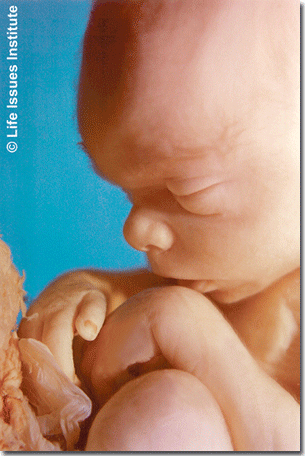
Since when is modern man consistent about anything? Any genocide requires arguing that the victim class is sub-human. Abortion requires exactly that premise about the fetus. You look at the pictures and you an see that is nonsense.


Given the seriousness of the sins and the number of people struggling with them they hardly mention it at all.

I just want to point out the "seriousness of the sins" is precisely what I mean by a high degree of church focus. The fact that they are considered to be serious sins... I understand your objection that you don't think the church is aggressive enough on these issues ...
Most don't consider sex to be a trivial matter. So I am not sure that saying sexual sins are serious is such a surprise. The point is the church's position has not changed in substance. In terms of the tone and frequency of the teaching it is less about rules and judgement and more about love and forgiveness. Often the church is criticized by people for guilt tripping them and talking about hell all the time. I wonder where they go to church. That kind of preaching has not been the rule for many decades now.

Mostly because people feel guilty. They like to blame the church but it is their own conscience that tells them they are doing wrong.

I don't see that. I think the data on premarital sex being wrong, homosexual sex being wrong, masturbation being wrong is pretty clear that huge and growing percentages of the population simply aren't troubled by these sexual acts.
They say they are not troubled. We have created a society where it is politically incorrect to admit you have a conscience. But many come to the church privately and admit they are troubled. There are those "whose consciences have been seared as with a hot iron (1 Tim 4:2)" but they were not born that way.  It is like swearing. Your conscience bothers you for a while but then it doesn't in the same way. 

You think so? I think wealth distribution is a pretty recent phenomenon.

I think we mentioned this before on the rise of Islam and how important the end of debt and slavery was. That's a great example. Going back even further Book IV of the Republic discusses the distribution of property and how this effects the nature of the good. The old testament specifically outlines the the corners of fields are community property though the interior is private property.
You can call that "wealth distribution" if you want. There is some minimal recognition of rights for the poor. To prevent them from starving. Not really creating a middle class. Often even these rules were not followed. I am not totally familiar with the slavery issue in Islam. From what I can tell Islam changed slavery. They didn't abolish it. Prisoners of war became slaves. People, if they were Muslim, were not made slaves to pay off debt. I guess if you have a culture of war that works.