Friday, January 13, 2012

Are Protestants Still Protesting?

Are Protestants Still Protesting? If you had asked me that 20 years ago I would have said No. My experience growing up reformed was embracing the reformed traditions and Calvinist theology. We didn't see them as a rebellion against Catholicism or anything else. We were pursuing truth and holiness and that was that.

But things have changed. This discussion over I Like Jesus But Not Religion is typical of what you hear from protestants a lot lately. They distinguish themselves from traditional Christianity. They don't say Catholicism partly because it would be offensive and partly because there are more Christian groups they would include as traditional. But the aim is clear. They want to paint themselves as different from what people think of as Christian. People are not interested in traditional Christianity. We want to show them Jesus without that. That starts by affirming that they were right to reject the traditional worship Christians have always engaged in. This is even done within the same denomination. The reformed, liturgical worship I grew up with is often mocked by modern reformed pastors. It is seen as a great evil. Something that caused a lot of young people to leave the faith.

But when you protest previous generations of Christians what are you protesting? What protestants would call the church. They would not think of this but what is their definition of the one, holy, Catholic, and apostolic church? They say it is the collection of all the saved both living and dead. How is that different from what they are attacking when they rail against those churches with empty ritual and judgmental sermons? Are they saying none of those people in those traditions were saved? They seem to come close to saying it. It just isn't sustainable. Those traditions represented almost all protestants up until around 1950. You start to think of names like CS Lewis and Corrie Ten Boom. Very few protestants would start to argue they were unsaved.

You can see what is happening. They are not protesting the Catholic church by itself. They are including a bunch of protestants that are lumped in with the Catholics. They are getting the same issues. All that is happening is the line between "good modern Christian" and "bad historical Christian" is being drawn differently. But they are still rejecting what scripture calls the Bride of Christ or the body of Christ or the family of God. They don't want to be identified with historical Christianity. They want to emphasize all the ways they are different. That they have somehow fixed this broken thing called Christianity. 

Ultimately it is not an emphasis on Jesus but on the pastors. They try and emphasize Jesus. They really do. But you say previous generations were wrong and you are right. Was Jesus there in previous generations? Sure. So what has changed? What fixed this big problem? New human leadership. So Jesus without the hip new pastor is bad? How do you get away from that?

Tuesday, January 10, 2012

Feeling God

I was reading about a Barna study about young people and church.
One category that was monitored was connecting with God, which the study described as the most important outcome to churches.
According to the study, 66 percent of churchgoers said they have had a personal connection with God during church service, while one-third of churchgoers never felt a connection God during church.
The report says that 44 percent of people who attend church weekly feel God's presence every week and 18 percent feel God on a monthly basis.
What struck me was the emphasis on feelings. What the churches described as important was "connecting with God." That is a great thing for a church to desire for it's members on Sunday morning. But then the responses from the members added that extra dimension. Feelings. Do I feel connection with God? That is a huge leap.

As a Catholic I go to mass to connect with God. Jesus is objectively present in the Eucharist. That means He is there whether I feel that connection or not. I want to feel His presence but reality is more important than my feelings. I need to believe on faith that the connection happened whether I feel it or not.

This is a huge distinction. If you approach Sunday mornings from a  perspective of how can I manufacture a feeling of God then you are liable to go very far afield. What if you feel God more when you go fishing then when you go to church? Should you go fishing on Sunday morning? What if the church that makes you feel God's presence also teaches heresy? I had that issue as a protestant. I was Reformed in my theology but felt more inspired by Pentecostal services.

What I need is a way of worshiping God that does not depend on my feelings because they change like the wind. That is what the mass gives me. I was actually Catholic for a while before I realized I needed this. I was actually happy with my feeling-driven Sunday morning experience.

Then there is talk about "gained new spiritual insight" or it "affected their life greatly" or "they experienced transformation." You do expect these things from a church but you would also expect these things if you were "tossed back and forth by the waves, and blown here and there by every wind of teaching and by the cunning and craftiness of men in their deceitful scheming" (Eph 4:14). If we continue to embrace the same faith more and more deeply then the change should be more organic. Like a tree grows over the years but you don't think of it as experiencing transformation. Your new insights might be new fashions rather than real growth.

Monday, January 9, 2012

Christians and Persecution

Timothy Dalrymple discusses whether Christians have a persecution complex. It turns out to be about the "War on Christmas." That is something I have not noticed this year. What I have noticed is persecution of Christians around the world. Violently in many places in the world and more politically in the west but increasing at an alarming rate all over.

Tim's post does a good job of addressing the fact that Christians have not really claimed the Christmas issues were persecution but I wonder if we should have. It is becoming clearer and clearer that western society is drifting towards persecution of Christians. The Christmas issue has gone away mostly because other issues have cropped up that are worse. We are now talking about Christians being excluded from government programs unless they agree to support abortion. Christians being fired from their jobs for disagreeing with gay marriage. Christian adoption agencies being shut down for believing children need a mother and a father. These are not possibilities. These are things that have already happened.

The future is looking even worse. The government is setting a very dangerous precedent by making conscience exceptions much narrower than they have ever been. These are clauses in laws that mean government can't force religious institutions to act against their faith. So if a head of a Christian ministry is caught in a sex scandal he can be dismissed on religious grounds and the government can't force the ministry to rehire him because it meets their definition of an unfair dismissal. These protections have covered a lot of church and para-church organizations in the past. The plan seems to be to change that. It is right now focused on contraception and health insurance but the principle is broad. It has the potential to attack any pro-life or pro-marriage organization.

It is the tyranny of sentimentalism. All you have to do is imagine someone who will be hurt if you don't do that. The person does not need to exist. It is not like there were millions of people in agony from being wished Merry Christmas. You just act as if there are. How many gay couples were really hurt because they could not use a Catholic adoption agency? It does not matter if there are none. There are going to be some activists who will claim offense. You can't prove they are lying. So that is enough. Sentimentalism is not about others being hurt. It is about making us feel hurt vicariously. Reality does not matter. If we can imagine a gay couple would feel devastated and not just go to another agency then we are there. Sentimentalism is really self-centered. It is our feelings that matter. We only pretend to care about another person.

I wonder if God is not sending us persecution because we don't care enough for our persecuted brothers. Studies show that Christians are by far the most persecuted religion word-wide. But over 80% of Christians live in countries where Christianity is the majority religion. So we tend not to care about the 200 million or so Christians living under persecution. Christian countries have done little to protest these incidents. So maybe if God gives us persecution here we will start to care. So next time you see a story of some Christian person getting fired or some Christian organization losing funding because of their faith, pray for them, but also pray for the Christians dealing with violence in Egypt, India, Nigeria and many other places.

Friday, January 6, 2012

Saint and Lions


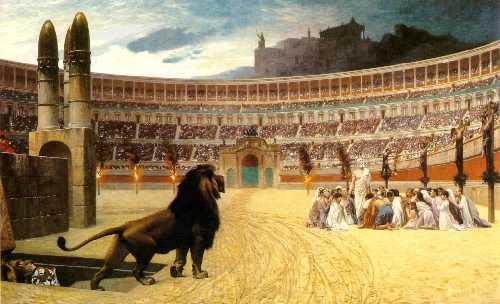
Saints usually win. They win over kings and emperors. They win over philosophers and armies. They even win over popes. But there is an exception. Lions beat saints. St Ignatius is the most famous example but there were many saints who were fed to lions. I did find one, St Blandina, who was miraculously not eaten by the Lions but even then the Lions did not get eaten. St Blandina was still martyred. So it seems that when Saint and Lions meet that the Lions do pretty well.

Politics and Justice

School of Athens by Raphael
I find US elections hard. I like politics. I just don't like watching Christians engage in politics. The accuse each other of all sorts of things. They also tend to twist their theology inside out to fit their politics. It is not pleasant to watch. But the election seems to dominate all the talk these days. It is hard to avoid.

I don't think we should avoid it. As Christians we should look to transform politics and make it more Christ-like. The opposite is more the rule. Politics transforms Christianity and makes it more political. What we are to work on as Christians needs to be bigger than one political race or even a political party. We should all read Pope Benedict's' address to the German parliament where he talks about how politics and religion should interact.
Politics must be a striving for justice, and hence it has to establish the fundamental preconditions for peace. Naturally a politician will seek success, as this is what opens up for him the possibility of effective political action. Yet success is subordinated to the criterion of justice, to the will to do what is right, and to the understanding of what is right. Success can also be seductive and thus can open up the path towards the falsification of what is right, towards the destruction of justice. “Without justice – what else is the State but a great band of robbers?”, as Saint Augustine once said . We Germans know from our own experience that these words are no empty spectre. We have seen how power became divorced from right, how power opposed right and crushed it, so that the State became an instrument for destroying right – a highly organized band of robbers, capable of threatening the whole world and driving it to the edge of the abyss.
I could not really find a quote that does it justice. You kind of need to read the whole thing. But he did not talk about one party or one issue. He talked about what is the core motivation. First of all, it must be about justice rather than winning. But then he goes on to ask where your sense of justice comes from. How we need to merge our morality and our reason to get there? Can we bring Athens and Jerusalem together?

Then he did something that reminded me of a CS Lewis quote that can be found in something Mark Shea just linked.
This thing which I have called for convenience the Tao, and which others may call Natural Law or Traditional Morality or the First Principles of Practical Reason or the First Platitudes, is not one among a series of possible systems of value. It is the sole source of all value judgements. If it is rejected, all values are rejected. If any value is retained, it is retained.
What the pope sees is that if he can sell Germans on one value he will have sold them on the whole concept of morality. What value did he choose?  Environmentalism. Something Germans have embraced big time. That is one way that people have seen "that the earth has a dignity of its own and that we must follow its directives." If we can see what is natural ought to be preserved ecologically then we have moved from "is" to "ought." That can lead to the same kind of "ought" in preserving what is natural socially. Like the sanctity of life and the integrity of marriage.

The point is that we need to think rationally about what ought to be. We should pick politicians that do that well. Sure you expect them to avoid certain wrong answers. But how do they avoid them? Do they make a political calculation? That is do they decide based on winning rather than justice? If so, then they are worse than those who decide based on a warped view of justice.

I must say the choices all look pretty poor when evaluated on this basis. I don't see any candidates that consistently make choices based on justice rather than winning. I guess that is because they don't win. Santorum seems to do so on social issues but not on issues of national security. There he seems to follow the polls. Paul seems interesting but I don't know enough about him. He seems a little unbalanced but I can't point out exactly why.

People elect the same old type of politician again and again but they always seem to want someone different. It is like we know these guys are not what we need but we don't demand better. Justice gets hard. Politicians mostly fold when anything gets hard. That is the problem with guys who are focused on winning. That is all they will accomplish is winning. But that problem is not just with the candidate. Many of the supporters have the "just win" mentality. They are not concerned with leaving behind a better society. At least not concerned enough to risk their political life for it. It is rare to find candidates like that. Santorum and Paul seem like the only guys out there who believe something strong enough to stick by it no matter the cost. Guys with that kind of courage can do great good or great harm. That is why we need to understand where they get their ideas about right and wrong.

Wednesday, January 4, 2012

Are Good People Boring?

We got season 5 of the show House for Christmas. One plot line has Dr House finding out embarrassing details of the various character's lives by hiring a private detective. There is one character, Foreman, he can't find any dirt on. House dismisses him as boring. Then they have a follow-up conversation reenforcing that comment that this Foreman character, who is the only moral character on the show, is boring.

Now in thinking about this post I am reminded of some debates about World Cup Soccer. I have pointed out that if you have to argue something is not boring then you are already in a lot of trouble. So I don't want to go there. I do think we often find good people less superficially attractive. There are a bunch of reasons for it. One is because we like to sin vicariously. We don't want to do drugs but we like to hear about any excitement generated by them in someone else's life. We don't cheat on our spouse but we want all the details when someone else does. It is an affection for sin. It can rob us of our spiritual joy. That can make us boring people.

The other problem is we are scared to look too close at good people. Certainly fiction will dig endlessly into the depths of evil. We love Macbeth and Romeo and Juliet because of their tragic flaws. Hollywood has endless attempts to plumb the depths of drug addiction and sex addiction and whatever else. But what about what makes a good person tick? When you explore goodness humans feel pressured to respond. They feel like you are preaching at them. When you show the source of a character's goodness you issue an implicit demand that everyone pursue that source too. That is the nature of goodness. If we fail to pursue it we are failing as human beings.

I was at a hockey banquet last night. There were a couple of inspirational speakers there. I found they suffered from this as well. They had their lives changed by coming into contact with something good. But they refused to explore that good thing in any depth. Why not? Because when you do you are talking about religion. When you do that it demands a response. Often these stories are Christian stories with the God talk removed. Someone suffered terribly and through their faith in Jesus they were able to move from being an angry person to being a joyful person. People hear that and think it it is an incredible story of the human spirit. That the God stuff is just an aside. But it is not off to the side. It is the foundation. Why was this person OK with a life that was very different and in some ways much less than the one he had dreamed of? Because he believes God meant him to be what he is and not what he dreamed. Once he gets that the envy and anger can melt away he can be truly joyful. But if he believed it was just bad luck that took away his dreams then why should he not be angry at life and envious of those who get to live the life he dreamed of?

So how could the House writers make Foreman more interesting? Give him a compelling reason to be good. Don't just take away the sin and replace it with nothing. Certainly don't take away the difficulties in life. Good people have challenges. Most of the suffering on the show is self-inflicted so Foreman has none. That is not real. You still suffer. Your suffering just does good. Love does amazing good but it opens us up to suffering. It is not boring.

Thinking about it makes me wonder how much contraception has played a role here. Certainly contraception makes marriage boring. The protestant endorsement of contraception is really a big embrace of boredom. God wants to make you fruitful but you can be safe instead. You can have a sterile Christianity where you don't do anything good or bad. God wants our cup to run over and we just want to turn it off. Half full is fine ... and water please because wine is to dangerous!

Sunday, January 1, 2012

A Pope Benedict Quote

From Pope Benedict's book Jesus of Nazareth II (p241-2):
The Christian faith stands or falls with the truth of the testimony that Christ is risen from the dead.

If this were taken away it would still be possible to piece together from Christian tradition a series of interesting ideas about God and men, about man's being and his obligations, a kind of religious world view; but the Christian faith itself would be dead. Jesus would be a failed religious leader who despite his failure remains great and can cause us to reflect.  But he would then remain purely human, and his authority would extend only so far as his message is of interest to us. He would not longer be a criterion; the only criterion left would be our own judgement in selecting from his heritage what strikes us as helpful. In other words we would be alone. Our own judgement would be the highest instance.
This is written about the resurrection. It strikes me how similar it is to the problem with Sola Scriptura. That the resurrection makes Jesus the ultimate criterion. He is the one true mediator between man and God. But the moment that mediator leaves this earth we have the same problem again. We are left with merely human authority that is only going to extend as far as it interests us. Unless we aren't. Unless there is an authority on earth that is more than human.

This is the insidious thing. Protestants claim their authority gets the important things right. So what is the big deal? The problem is that reduces Christianity to something human. You and the thinkers that interest you decide what is important and what are the right answers on those issues. That is the end of the public part of Christianity. The private part of Christianity is still there where we pray and reflect and try and follow Christ. But "what strikes us as helpful" is even more central in our private discernment than it is in our public confession. For me and many protestants I knew that sense is assumed to be God's voice. It can be God's voice. It can also be our own pious imagination. How do we know? We don't. Not unless we have some discernment that we trust more than out own.

Mary is a good example of something that does not interest protestants. There is an assumption that because I don't have a desire to meditate on her role in salvation that it must be unimportant. We read the bible, we pray, we just don't feel led to think about Mary. Is that God telling us she does not matter? Not at all. It is your human tradition becoming an echo chamber and drowning out God. Unless there is an authority that can demand we go beyond what interests us then there is no way out. Then Jesus is not really alive to you. You are still in an entirely human situation.

It sounds harsh. If you reason in good faith and try to follow God why should that not work? But that is why we needed Jesus. People reasoning in good faith was not adequate. He came to give us something better. A new covenant. But we also need a new covenant community. We need to encounter the true Jesus and not just ideas about Him. Even very pious and sincere ideas are not good enough. We need the way, the truth, and the life. Not just from one of the many who claim to have Jesus figured out. From the mystical body of Christ itself.

This is what Bryan Cross was saying with his now-famous Ecclesial Deism article. That Sola Scriptura turns Jesus into "a failed religious leader." Still a very interesting figure but not a criterion. At least not a knowable criterion. No matter how many good things grow from that foundation they are ultimately human things. For we are alone with our judgement. God is not with us.