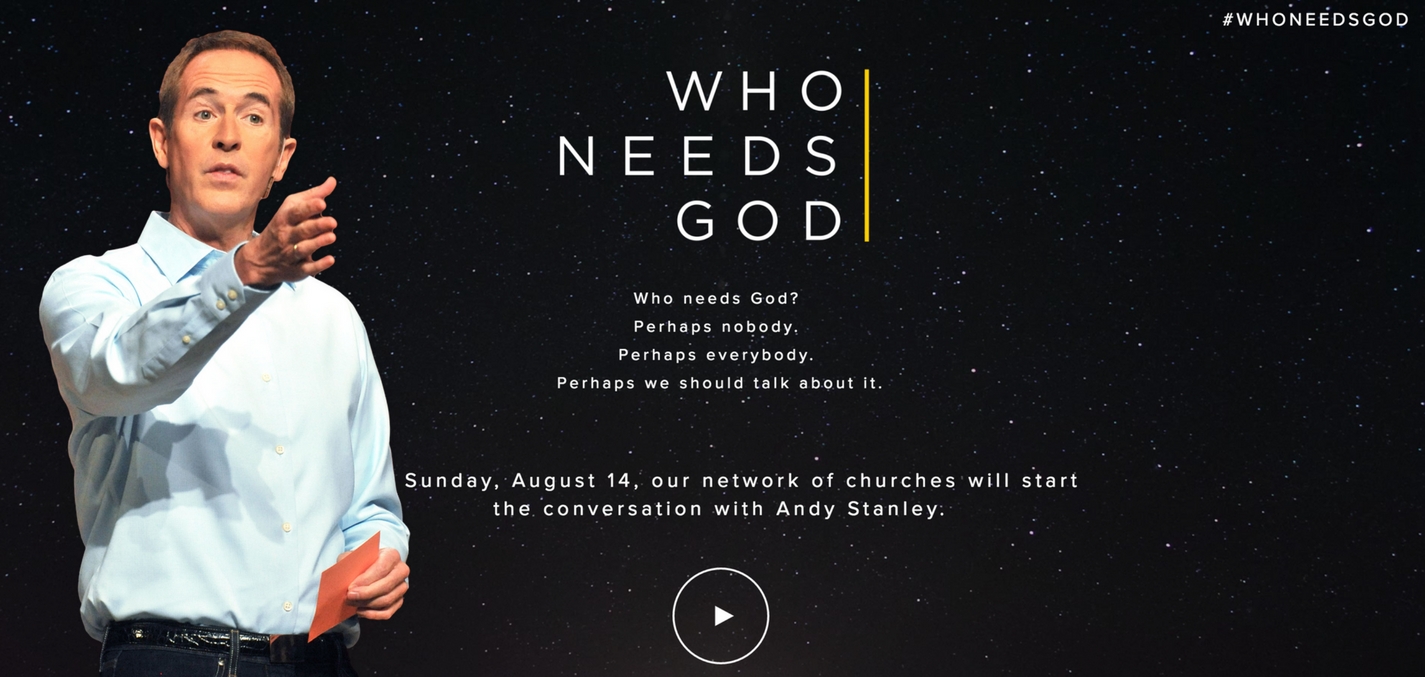
At our parish men's group we are watching the Who Needs God videos by Andy Stanley. They are quite well done. We have not made it through the whole series yet but he is making some of the same points I have made. He makes them a lot better. He is an exceptional communicator. The basic message is that the rise in atheism has nothing to do with the notion that atheism has suddenly become appealing. In fact, many who leave Christianity do not associate themselves with atheism. They call themselves the Nones. That is when asked which religion they are they don't say Atheist. They say None.
He actually points out many of the conclusions many of the leading atheist thinkers have come to. They take seriously the possibility that there is no god and try to make sense of life. It is hard. We become the centre. All meaning is centred around what we feel is meaningful. All morality is centred around what we feel is right. Yet can we trust our feelings? The answer is No. We know people who based their life on what they felt is good and meaningful and got it terribly wrong. Do we have any reason to believe our own feelings are immune from such serious errors? No.
The conclusions that atheist philosophers draw are much worse. About free choice being an illusion, about love and beauty having no real value, about the human person being indistinguishable from animals and even machines. These are all out there but I am not sure he went over them in enough detail to convince anyone who was not already convinced. Still he does enough to show atheism, if true, is a terrible truth. It does not just declare God to be a delusion but it says anything you have ever thought worthwhile about your life or anyone's life is a delusion as well.
Then he moves on to his main point. He says the real problem is not that atheism is appealing but the real problem is that people are latching on to wrong notions of theism. What is being presented as authentic Christianity is actually an incoherent theology that people eventually reject for good reasons. He lists a number of these. He is mostly right. These ideas are out there. They do not make sense and they are not taught by traditional Christianity.
The trouble is he is declaring all these teachings to be heresy. He needs to do that. Yet he does not claim the authority to be able to do that. Andy Stanley does not claim to be able to define what doctrines Christians must believe and what heresies they must reject. Yet he does exactly that. He gets away with it rhetorically. You can always do that. You can say this other idea makes no sense or it is unbiblical or whatever. Yet if you put him side by side with someone who believes one of these ideas it would not be so clear which is the biblical one or which is the logical one.
How can you make it clear? Typically the only way to make clear which is the orthodox teaching and which is the heresy is to appeal to tradition. To go back to prominent Christian thinkers from previous generations and show that what they are teaching is not in line with what Christians have historically taught and what you are teaching is in line with them. Yet that line of reasoning is precisely what protestants rejected in the reformation.
This is why we have atheism. Christianity is a complex faith. It is important we get it right. If we distort it in some way we can end up in an incoherent belief system. Then we are asking people to spend their lives on something that does really make sense. They are not going to want to do that.
The controversies get harder. So far he has stayed away from the questions around sexual morality. I am surprised because he claims to base these talks on reading many de-conversion stories. That is stories of Christians losing their faith either to become an Atheist or become a None. I have read a fair few of those stories too. Many of them talk about sexual morality. That can reduce their credibility. Christians can dismiss them saying this guy just wanted to engage in a certain sex act and his faith told him No so he ditched his faith. Sometimes that is accurate but often it is not.
Even people who are married and faithful have questions. Can I tell someone who is not married and in a sexual relationship that they need to stop having sex or get married? Can I tell a woman who is pregnant and sees huge problems with having a child that she should not have an abortion? Can I tell someone who is same-sex attracted that sex is for marriage and marriage is for a man and a woman? For all these questions the answer may well be Yes but you don't want to say that unless you are sure you are right. Can we be sure we are right? Can we know God's truth on these questions with any sort of certainty? If not, then why bother with Christianity? If so, then what do you reply to all the liberal Christians who claim you are wrong?
Only in truth does charity shine forth, only in truth can charity be authentically lived. Truth is the light that gives meaning and value to charity...Without truth, charity degenerates into sentimentality. Love becomes an empty shell, to be filled in an arbitrary way. Pope Benedict XVI
Sunday, May 6, 2018
Saturday, April 7, 2018
Atheism and Modern Paganism
We see a lot of paganism about. My child loves the movie Moana which is about gods and demigods and being characters being told by the ocean what their purpose in life is. We see characters like Thor and Loki coming back. Wonder Woman has Zeus as part of her story. These religions have been discarded for a long time. Why are we as a society coming back to them?
What is happening is we have rejected the Christian story. Art wants to point to something true and good and right. Yet they are no longer able to point to explicitly Christian definitions of that. Why not? One big reason is that many people mistakenly believe Christianity can't stand up to logical scrutiny. That it is not true. Leaving aside for now why that is, it becomes a lot easier to say something comes from Zeus or Odin rather than from Jesus.
What they really want in most of these stories is a sense of purpose in life. Who are you? What are you mean to be? How can you tell when someone lies to you about who you are? How do you know your true purpose? The story tellers want these questions to have answers and for the characters to find these answers as the story unfolds. This makes sense. We love stories like this because we believe that our lives have meaning and purpose. We believe that we can get confused about what that purpose is. We believe that clearing up that confusion can change our lives dramatically for the better. It can be what one might call a conversion experience.
So what's the trouble? Well, the reason why we rejected the Christian story is because it did not stand up to logical scrutiny. Guess what? These stories don't stand up either. In fact, they do much worse. That is why they were rejected in favor of Christianity. So why accept these?
The reason is because atheism is unlivable. What would an atheist story look like? A young person has a restless heart because they feel they are meant for something more. Then he is told that feeling is a lie. He is not made for anything at all. He is just a random configuration of DNA. He thinks his life matters because his brain has evolved to make him believe that lie. He is just wrong. His birth, life and death are completely meaningless events. The end. So who would see that movie?
They say if you reject Christianity you don't end up believing in nothing. You start believing in anything. Deep down inside we know that the pathetic answers atheism give to life's big questions are not really true. So we pursue sex or drugs or Marvel movies as the answer. We know they are not but our hearts want to love something.
Does this prove atheism is false. Not logically. Yet is seems to make it inherently implausible. Why would the human person find the truth so intolerable? If that is the case it is a horrible state of affairs. The only way we an be happy is to tell ourselves a lie. Yet we inherently hate lies.
It eventually comes to a point where Pascal's wager makes sense. If atheism is true then we can never be truly happy. None of our friends or family can be truly happy either. Humans just have no place of peace. So we gain nothing by believing it. We just end up with a joyless life that ends in a meaningless death. So if atheism is true the truth is so horrible that we have almost no choice not to face it and try some sort of escape.
So why not try the escape that actually benefits you if atheism is not true? Why not embrace the greatness and joy Catholicism? If it turns out to be true you gain everything. If it turns out to be false you still gain. You have at least placed a bet that has a chance to win.
Why Catholicism and not some other religion? Of course that is a fair question that has a good answer. Not as hard as you would expect. Science and history go a long ways to eliminating other religions. Is it that hard to know Zeus and Thor are not candidates? People who seriously ask the question of which of the many religions has a real chance to be true typically arrive at Catholicism very quickly. Jesus stands out among religious figures. Catholicism stands out among all the flavors of Christianity.
Sunday, March 25, 2018
Why Should The Devil Have All The Bad Music?
This is a time of you where Catholics are trying to walk with Jesus through the passion. We try to connection our suffering with those of Christ. That can not only make us feel better but give our suffering salvific significance. That is our pain becomes a powerful weapon is the spiritual battle to save souls, including our own. This is a doctrine protestants reject because they get salvation wrong. I won't get into that here but it matters in practice because much of our Christian music comes from protestants.
I recall something I read a while back about Christian music being excessively happy.
This just documents what many have said. That is that Christian music is great when you are happy and feeling good. It is not so good when you are in pain. Now Christians should always have a deep underlying joy and our music should help us connect with that. It is good we have music that does that well. Yet we still have pain. We still have deep pain that we cannot just ignore for a while when we sing some happy clappy songs on Sunday morning. Even the lesser struggles we have that we can set aside, is Sunday morning a time when we should set them aside?
If your theology does not really have a place for suffering you have no choice. That is not true of Catholic theology but many Catholics don't really get it. We can slip into protestant thinking because we live in a sea of protestants. We have a very secular culture but to the extent we have a Christian subculture it is very much a protestant one. We get that we believe in the Eucharist and the pope and they don't. Yet other differences like the way we think about suffering come out in more subtle ways and impact us a lot.
One way it impacts us is we have no Christian art we can turn to in times of suffering. We don't even really think Christian art can address the subject. We can even go so far as to imagine Christian community cannot address it. It happens that someone who is in serious pain withdraws from Christian community because it does not go well. Often they can find secular art and secular community that can understand their pain. Yet the secular world has no answer. We need something that points us to the cross. Yet we have forgotten how to do that.
So that brought me to the title of this post. Larry Norman had a song a while back called "Why Should The Devil Have All The Good Music?"
What I am thinking has happened is the Devil has all the Bad Music. Not artistically bad but "bad" in the sense of music we listen to during bad times. Christianity needs to relearn how to write such music. It needs to relearn how to embrace the cross.
Sunday, March 18, 2018
Dying And Rising
The hour has come for the Son of Man to be glorified. Very truly I tell you, unless a kernel of wheat falls to the ground and dies, it remains only a single seed. But if it dies, it produces many seeds. Anyone who loves their life will lose it, while anyone who hates their life in this world will keep it for eternal life. John 12:23-26This is part of the gospel for this week. It is the story thing John records before moving into the crucifixion account in John 13. The homily we heard on it was about doing better morally and trying to make some incremental improvement in your life. It struck me how that is not at all what Jesus says here. Jesus call for a dying and rising. That is a radical change. It does not describe making a effort at an attainable improvement.
One big difference between the two is that one requires faith and the other does not. Trying to become a better person is something an atheist can do. I would suggest they don't have a coherent answer to what it means to be a better person but that is another story. They do feel the impulse to improve themselves and many of them do. It is all based on human motivation and human effort that does not need to be connected with God at all.
Dying and rising, on the other hand, does not make any sense if God is not real. Dying means you are completely helpless and you need God to raise you up. If God is not there then you will die and that will just be the end of it. This is why this story is told in the context of Jesus' death and resurrection. We can die to sin and be sure of our resurrection precisely because Jesus rose from the dead.
The objection to this is if you set your sights too high you will fail. Make the goal attainable and you are going to succeed. Is not some small victory better than one big defeat? First of all, you are not guaranteed a small victory. We can set our sights quite low and still fail to achieve the target. Secondly, and more importantly, failure does not have to leave us in a bad place. We tried to be a saint and we failed. That leaves us knowing we are sinners and still having a long way to go. So we need to do this conversion thing again and again. Our failure will remind us of our sinfulness again and again. This is good.
The line that was repeated so often is that in order to be a disciple we need progress but not perfection. I am not sure this is true. We don't need perfection for sure but I am thinking we don't even need to make progress. Long term you would wonder about a person who never makes any progress. Still in the short term you might not achieve even a little bit. Someone who tries to quit drinking might not be very successful at all. Do you have to show progress to call yourself a disciple? I would say just the fact that you want to follow God in this is enough. The fact that you did not even make progress today is not important. Tomorrow is important. Do you try again or do you give up?
It comes down to the difference between grace and works. Is God acting with our cooperation or are we acting and maybe getting some help from God? Christianity is very firmly in the former. We need God even for small progress. What follows is that difficulties are kind of irrelevant. Nothing is too difficult for God. What matters is whether we trust God.
Sunday, November 19, 2017
Silence
It took me a while to watch this movie. I had heard it was not that great. It the story of some Jesuit priests in Japan who suffer persecution and eventually apostatise. That is they give up the Catholic faith entirely and start working to oppose it. Such people did exist. They shocked Europe. Jesuits folding under persecution was unheard of. Yet we never really fully understood why. This movie offers one scenario I guess.
One thing that seems implausible about this movie is the priests never remind me of real Jesuits. Now the actors went to Father James Martin, a modern Jesuit, and tried to learn something of Jesuit spirituality. The trouble is modern Jesuit spirituality is very different from 17th century Jesuit spirituality. Modern Jesuits would apostatise in a New York minute. In fact, Father James Martin is know for arguing very liberal views. Some might say he has already come close to apostasy without much persecution at all. Just a little social pressure from the liberal academic elite and he folds like a house of cards.
These characters are like that. It does not take any pressure at all to get them to question their faith. They express very serious doubts very early in the movie before any real persecution has happened. Even the title of the movie, Silence, comes from there repeated confusion over God being silent. I have never heard a priest talk like they do. So the shock that is supposed to take place when the apostasy occurs is just not there. We more have the feeling of why are these spiritual weaklings being sent into this very hard assignment with no support?
The thing that really bothered me about this movie is how pro-persecution it was. There was this constant narrative that Christianity was causing problems for Japan and nothing good was coming from it. That Japan was totally justified in using torture and murder on a large scale to deal with this problem. That religion can be effectively stamped out by getting the leaders to publicly oppose the cause of Jesus. Even when you do this using the worst forms of torture those turned leaders will still be effective in opposing the faith.
This is scary in today's day and age. Atheism is on the rise and one wonders how quickly our society can forget about freedom of religion. We have a society where many talk about how annoyed they are that Christians seem to cling to their beliefs. How could we deal with that? Could western society turn to violence to try and stamp out Christianity. If you are looking for movies that try and suggest that then you will like this one. It is all about how great it is when the state bans Christianity.
These Jesuits make none of the arguments you expect Jesuits to make in this situation. So many lame objections to the faith remain unanswered. You look at a Jesuit like St Edmund Campion who articulated the faith so well under the persecution of Queen Elizabeth I. Even a Jesuit like St Francis Xavier who founded the Catholic church in Japan and deserves a movie much more that these guys.
One idea that goes unchallenged in the movie is that the brutally violent rulers who stamp out the faith will suddenly become nice benevolent rulers once Christianity is gone. That state sponsored torture and genocide will stop on its own and human rights will start to be respected because these people gave up their faith. Nothing could be less likely. Evil does just go away. The way to defeat evil is the encounter Jesus. Without Him government brutality would continue without limit.
The movie does show the heroic martyrdom of many Japanese Christians. It repeatedly points out that they are simple peasants. Suggesting the problem is the people who have planted such ideas in their minds. The people actually doing the killing are not seen as the problem. Yet the beauty of their faith still comes through. You wish for the priest to find such courage but he never does.
If they theory is right and the reason the priests apostatised was because their faith was really not the Catholic faith but actually a 17th century version of the modernist heresy. If such a thing is even possible. If that is what happened in Japan then it is a sobering warning of what could happen in the west. The worldwide Catholic church cannot be destroyed but major countries can have the church wiped out for centuries at a time. Could that happen here? Could our clergy become open to the idea that the Christian faith is not something we should die for but rather something we should be pragmatic about? That there might be a better strategy to improve society than offering the word and sacraments of Jesus Christ? You would hope that with so many more priests and bishops that at least some would stand up to the pressure. Still the conversations between the Japanese inquisitor and Jesuit priest are not that hard to imagine happening in the west with liberal priests and secular politicians.
Sunday, November 12, 2017
Just Enough Religion
Today we focus on Matthew 25:1-13:
The story of the 10 virgins is quite simple. The foolish virgins have just enough oil to get them to the wedding banquet. The wise virgins have extra oil. They are virgins so they are not big sinners. They are waiting for the bridegroom so they are not without faith. Yet some of the virgins have just as much oil as they have figured out they need. The trouble is they miscalculate and end up missing out. It seems unfair.
You hear that a lot. People think they are doing OK with respect to religion and expect God will not condemn them to hell. After all they are descent people and they have not completely ignored religion. God is merciful. There is nothing to worry about. Jesus is suggesting there is something to worry about. The road is going to be longer and harder than you expect. If you think you will be OK you should think again.
In fact, Jesus goes one step further. He suggests in verse 12 that these 5 foolish virgins don't know God at all. How can that be? It is not like they brought no oil at all. The trouble is they asked how little they could do and still be saved. How could they avoid hell and still live fairly normal lives. That is the wrong question. That is the question we ask when we don't really know God. When we know God we ask how much can we do. We ask if there is anyway I could show more love for God or help my neighbour more. That is a question that will totally transform your life if we ask it and really mean it. Yet it is what we ask when we encounter God.
So in some ways the lack of extra oil is about faith expressing itself in works. Not expressing itself in doing some works but really expressing itself by dominating the life of the believer. It is precisely the kind of religion our culture refuses to accept. You can be Christian but don't be a fanatic. Spend you Sunday mornings any way you want but don't let it transform the way you look at the world. Accept what we accept. Be politically correct. Colour within the lines.
Personally we think that way as well. We want to be Christian but we don't want it to interfere to much with our fun. Do enough to get saved but you real source of joy is the things of the world. We get caught in that kind of thinking all the time. We don't really believe that. That is not our creed. Yet our hearts go there again and again. In some ways it is the root of all sin.
The Parable of the Ten VirginsHere Jesus is giving us some final instructions and does so with 3 illustrations. Matthew 25 is the last chapter of the gospel before we go into the crucifixion and resurrection stories. So we are dealing with the final points of Jesus' teaching ministry. The 3 points are the stories of the 10 virgins, the talents and the sheep and the goats. All stories about people who seem to be on the road to heaven yet some of them make it and some of them do not. Do Jesus is giving us warning. Don't do these things. You might not receive the salvation you are expecting.
1“At that time the kingdom of heaven will be like ten virgins who took their lamps and went out to meet the bridegroom. 2Five of them were foolish and five were wise. 3The foolish ones took their lamps but did not take any oil with them. 4The wise ones, however, took oil in jars along with their lamps. 5The bridegroom was a long time in coming, and they all became drowsy and fell asleep.6“At midnight the cry rang out: ‘Here’s the bridegroom! Come out to meet him!’7“Then all the virgins woke up and trimmed their lamps. 8The foolish ones said to the wise, ‘Give us some of your oil; our lamps are going out.’9“ ‘No,’ they replied, ‘there may not be enough for both us and you. Instead, go to those who sell oil and buy some for yourselves.’10“But while they were on their way to buy the oil, the bridegroom arrived. The virgins who were ready went in with him to the wedding banquet. And the door was shut.11“Later the others also came. ‘Lord, Lord,’ they said, ‘open the door for us!’12“But he replied, ‘Truly I tell you, I don’t know you.’13“Therefore keep watch, because you do not know the day or the hour.
The story of the 10 virgins is quite simple. The foolish virgins have just enough oil to get them to the wedding banquet. The wise virgins have extra oil. They are virgins so they are not big sinners. They are waiting for the bridegroom so they are not without faith. Yet some of the virgins have just as much oil as they have figured out they need. The trouble is they miscalculate and end up missing out. It seems unfair.
You hear that a lot. People think they are doing OK with respect to religion and expect God will not condemn them to hell. After all they are descent people and they have not completely ignored religion. God is merciful. There is nothing to worry about. Jesus is suggesting there is something to worry about. The road is going to be longer and harder than you expect. If you think you will be OK you should think again.
In fact, Jesus goes one step further. He suggests in verse 12 that these 5 foolish virgins don't know God at all. How can that be? It is not like they brought no oil at all. The trouble is they asked how little they could do and still be saved. How could they avoid hell and still live fairly normal lives. That is the wrong question. That is the question we ask when we don't really know God. When we know God we ask how much can we do. We ask if there is anyway I could show more love for God or help my neighbour more. That is a question that will totally transform your life if we ask it and really mean it. Yet it is what we ask when we encounter God.
So in some ways the lack of extra oil is about faith expressing itself in works. Not expressing itself in doing some works but really expressing itself by dominating the life of the believer. It is precisely the kind of religion our culture refuses to accept. You can be Christian but don't be a fanatic. Spend you Sunday mornings any way you want but don't let it transform the way you look at the world. Accept what we accept. Be politically correct. Colour within the lines.
Personally we think that way as well. We want to be Christian but we don't want it to interfere to much with our fun. Do enough to get saved but you real source of joy is the things of the world. We get caught in that kind of thinking all the time. We don't really believe that. That is not our creed. Yet our hearts go there again and again. In some ways it is the root of all sin.
Wednesday, November 1, 2017
The Price Of Atheism
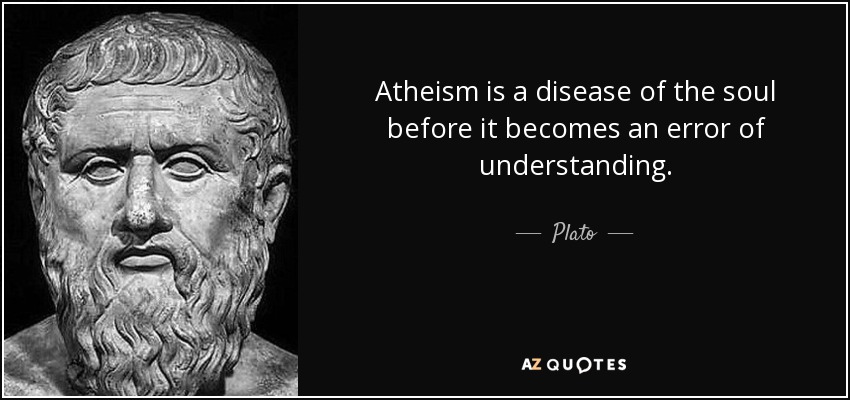
What is important to you? The odds are if you become a consistent atheist you will have to rethink it. Does knowledge matter to you? Do you like to learn about science or philosophy? Knowledge means nothing if atheism is true. Does love matter? Are the people closest to you the most important consideration at the end of the day? If atheism is true then love is an illusion. What about art or music? Do you see beauty as something worth sacrificing for and pursuing with great intensity? If atheism is true it is just a strange curiosity of evolution. What about meaning? Do you want to do something some day that really matters? With atheism is impossible even in principle for any human action or inaction to matter. What about goodness? Do you want people to say you always did what was right even when it was hard? That becomes incomprehensible with atheism.
Sure Christianity ask you to surrender everything. Yet Christianity gives you those things back again in a much better way. Knowledge matters because it is ultimately knowledge of God. Everything becomes reoriented towards God and gains meaning and significance. With atheism everything becomes reoriented toward nothingness. Really it becomes re-oriented towards your own brain but as a defect in your brain. Something that gave humans a survival advantage at some point in history. We got those things the same way we got our appendix or our baldness. It is just the way the genetic ball bounces.
Satan offers us a deal where he takes our soul and offers us nothing in return. Really when we talk about a person's soul we are always talking about those things that seem to go deeper than physical reality. It is not that there are unrelated to anything physical but there seems to be more there. Atheism has to say sense we have is flat out wrong. They don't have evidence to prove it is wrong. They have to accept it because it comes with the metaphysical assumptions they have made. This is precisely what they ridicule Christians for when they say they believe something on faith.
So atheism seems like it costs you nothing. When you go deep you find it costs you everything. Christianity is the opposite. It seems to cost you everything but after you embrace it you are much richer than you were before.
So why can't atheists see this? I mean the vast majority don't want to deny the importance of love and art and human dignity and whatever else. Why don't they see that rooting these things in the random processes of evolution is not going to give them the value they should have. Partly it has to do with a lack of philosophical training. People believe in human rights but they don't understand why they believe in human rights. It just seems clear to them. They don't see the connection to where we have traditionally said the human person comes from. All creatures are endowed by their creator with certain inalienable rights. If there is no creator where do the rights come from? There is very little attempt to wrestle with such questions. There is no real understanding how not having a logic foundation for something will mean it can disappear any time it is challenged.
The other reason is people just don't see Christianity as a viable option. They see it as anti-science and anti-sex and just not very respectable. They are wrong but it causes many to embrace atheism without any real reflection because they see not alternative.
Subscribe to:
Posts (Atom)